
So You Want to Become a Private Jet Flight Attendant? Here Is Everything You Need to Know
Maybe you stumbled across a video online. Maybe a friend mentioned the salary and your jaw dropped. Maybe you have always loved travel and wondered if there was a way to make it your career. Whatever brought you here, I am glad you found this.
I am Paulette Salisbury, Founder of LuxJet Group, and I have spent over 25 years in private aviation. I have worked alongside the crews who serve some of the most influential people in the world. I have seen people with no aviation background whatsoever break into this industry and build extraordinary careers. And I have seen people with impressive resumes never make it past the interview because they did not understand what this world actually requires.
This post is for the person starting from zero. No jargon. No assumptions. Just everything you need to know, explained clearly, from someone who has lived this industry inside and out.
First Things First: What Is a Private Jet Flight Attendant?
Most people picture a commercial flight attendant when they hear the word. The person walking the aisle on a Delta or United flight, handing out snack bags and reminding passengers to buckle up. That is one version of the job.
A private jet flight attendant is a completely different world.
Imagine stepping onto a sleek Gulfstream G650 or a Boeing Business Jet. There are six passengers on board. You already know their names, their dietary preferences, what they like to drink, and whether they prefer the cabin quiet or prefer conversation. Before takeoff, you have arranged their favorite meal from a top caterer, chilled the exact wine they requested, and prepared the cabin to their personal standard. From the moment the wheels leave the ground to the moment they land in Milan or Geneva or Dubai, every single detail of that experience is yours to manage.
It is one part fine dining server, one part personal concierge, one part safety professional, and one part trusted confidant. The passengers on these aircraft are CEOs, celebrities, diplomats, and high-net-worth families. They have chosen private aviation because they want an experience that commercial flying cannot offer. Your job is to deliver that experience flawlessly, every single time.
And unlike a commercial flight where you are one of eight crew members, on a private jet you are often the only cabin crew member on board. That means there is no one to hand things off to. The accountability, and the reward, is entirely yours.
What Does the Job Actually Look Like Day to Day?
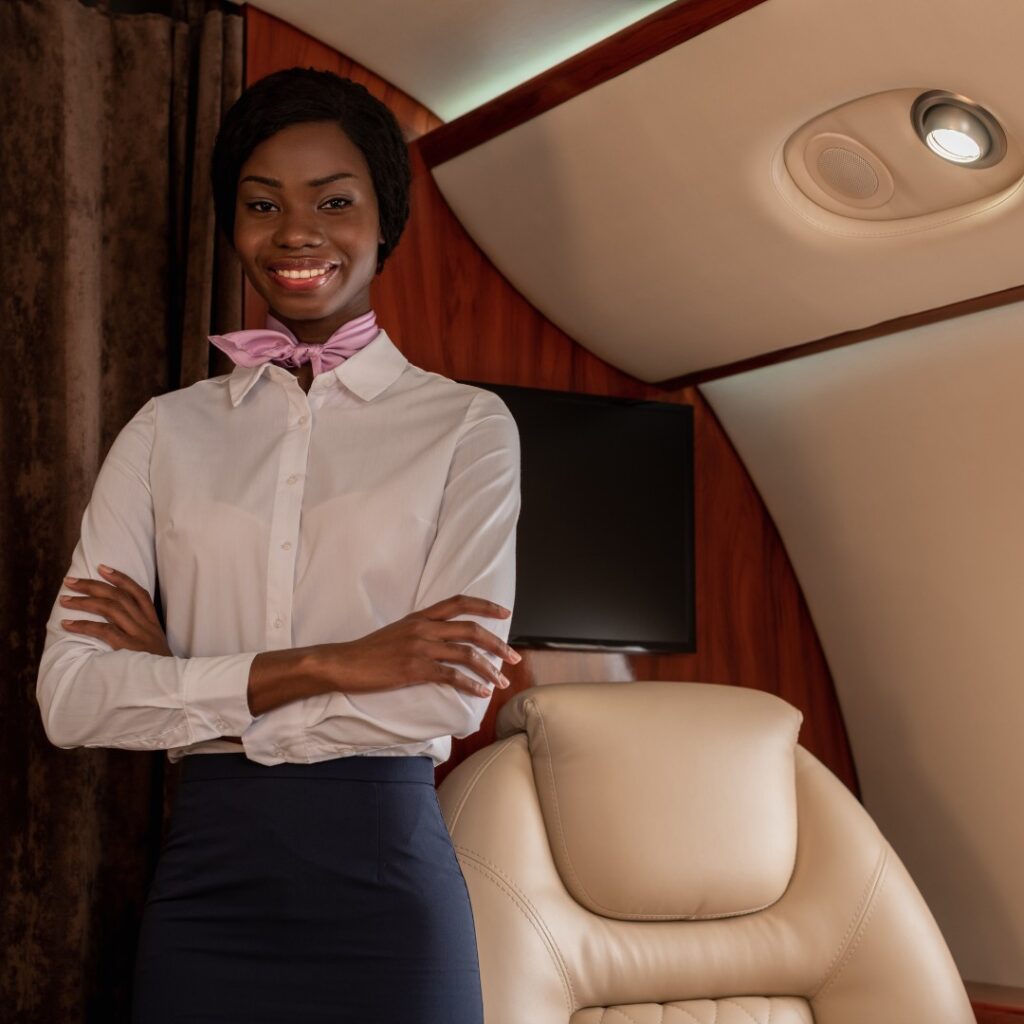
There is no such thing as a typical day in private aviation, and that is part of what makes it exciting. But here is a realistic picture of what the work involves.
Before the flight, you review the passenger manifest and any special requests. You coordinate with the catering company to confirm the menu. You inspect the aircraft cabin, check safety equipment, and prepare everything to the standard the client expects. You may be sourcing last-minute items because a passenger changed their mind or has a guest joining at short notice.
During the flight, you manage everything in the cabin. You welcome passengers, conduct the safety briefing, serve food and beverages at a fine dining standard, respond to requests, and make sure every person on board feels genuinely taken care of. If something goes wrong medically or mechanically, you are trained to handle it.
After the flight, you oversee the cabin, file any relevant reports, and debrief with the crew. If you are on a multi-leg trip, you prepare for the next departure.
The hours can be long and the notice can be short. A call at 10pm for a 6am departure is not unusual. This is not a nine-to-five. But what it gives you in return, the travel, the compensation, the quality of the work, is genuinely extraordinary.
Do You Need Aviation Experience to Get Started?
Here is the question I get more than any other from people just starting out, and I want to answer it honestly.
No, you do not need to have worked for an airline before. Commercial flight attendant experience is helpful but it is not the only path into private aviation. I have seen people transition successfully from fine dining restaurants, luxury hotels, high-end yacht service, and even event management. What they all had in common was an instinct for exceptional service, a polished professional presentation, and the drive to complete the right training.
What you cannot skip is the training. That part is non-negotiable, and it is where your journey needs to start.
The Training You Need: Where to Start and What It Covers
Before an operator will trust you with their clients, you need to prove you can handle the safety side of the role just as well as the service side. Private aviation has its own training requirements, and the two most respected providers in the industry are:
FlightSafety International and FACTS AirCare.
When an operator sees either of these names on your CV, they know immediately that your foundation is solid. These programs are what separate candidates who get callbacks from candidates who do not.
A complete private aviation flight attendant training program covers:
- CPR certification and advanced first aid
- Aircraft evacuation and emergency landing procedures
- Crew Resource Management (CRM) — this is about how crew communicate and make decisions together under pressure
- In-flight medical emergency response
- Aircraft-specific safety familiarization
- VIP service standards for the private cabin environment
The training itself typically takes one to two weeks. It is an investment of both time and money, but it is the single most important step you will take. Everything else in your career is built on top of it.
The National Business Aviation Association, known as the NBAA, is the industry body that sets the benchmark standards for private aviation in the United States. Their website is a valuable resource and worth bookmarking as you begin your research.
The Must-Haves: What Every Operator Is Looking For
Beyond the training, here is what operators genuinely require before they will consider you for a position.
- A valid passport with no international travel restrictions. Private jet clients travel globally on short notice. If you cannot get on a plane to London, Dubai, or Tokyo with a few hours’ notice, this career will be very difficult to sustain.
- A clean background check. This goes deeper than most people expect. Some operators will decline a candidate for excessive parking tickets. It speaks to character and responsibility.
- Willingness to sign a Non-Disclosure Agreement (NDA). The people you will serve share deeply personal moments in that cabin. An NDA is a legal commitment to protect their privacy completely. It is standard at every level of this industry.
- Professional appearance and presentation. Not about fitting a specific look. About presenting yourself at the standard the environment demands, consistently, on every flight.
- Genuine discretion. What you see on board, the conversations, the passengers, the details of the trip, stays on board. Permanently. This is not a negotiable quality. It is the foundation of every relationship in this industry.
- Flexibility and availability. Short notice departures, schedule changes, and last-minute calls are the nature of this work. The crew who build the best careers are the ones who show up reliably and without complaint.
The Qualities That Set You Apart: What Cannot Be Taught in a Classroom

Certifications get you in the door. These qualities are what build a long-term career.
Anticipation. The best private cabin crew do not wait to be asked. A glass is refilled before it is empty. A blanket appears before the passenger reaches for it. Knowing what someone needs before they know it themselves is the mark of truly exceptional service.
Warmth without overfamiliarity. Passengers want to feel genuinely cared for, not processed. But the line between warm service and being too casual is one operators notice immediately. Getting that balance right is a skill.
Composure under pressure. Flights get delayed. Passengers change their minds. Things go wrong. The cabin crew who get hired again and again are the ones who handle every variable with the same steady calm.
Pride in the work. The candidates who build the best careers in private aviation are the ones who genuinely love what great service feels like to give. This is not a job you show up to. It is a standard you hold yourself to.
What Does a Private Jet Flight Attendant Earn?
This is usually the question that brings people to this article in the first place. Here are honest 2026 figures.
- Entry level: $50,000 to $65,000 per year
- Experienced crew: $65,000 to $120,000 per year
- Senior and corporate flight department crew: $120,000 to $200,000+
- Dedicated crew for celebrity or UHNW clients: $200,000 and above
- Contractors: $550 per day to start, rising to $800 to $1,200+ per day as your reputation grows
Most positions also include daily per diem of $100 to $200 when traveling, with hotels, ground transport, and meals covered on every trip. The total compensation package in private aviation is almost always significantly better than commercial flying.
The Real Lifestyle: What Nobody Tells You Before You Start
Private aviation looks glamorous from the outside. And it is. You will stay in five-star hotels in cities most people only see in travel magazines. You will eat at remarkable restaurants and experience the world at a level that is genuinely rare.
But I want to be honest with you because I think you deserve that.
You will miss birthdays. You will get calls at midnight for a 5am departure. Plans you made weeks ahead will change without notice. The clients at this level do not plan their lives around crew availability. The crew adapt to the role.
The people who thrive in this career are the ones who went in with both eyes open, understood the tradeoffs, and chose it anyway. If that is you, this industry will give you back more than you put in.
Ready to Make This Your Career? Book a One-on-One Session With Me.
Reading about this industry is a great first step. But having someone who has spent 25 years inside it walk you through exactly what to do, where to train, how to write your CV, who to contact, and what operators are really looking for? That is a completely different conversation.
I offer private one-on-one coaching sessions designed specifically for people who want to break into private aviation the right way. We go deep on your background, your goals, and the exact steps you need to take to position yourself for the role you want. No generic advice. No guesswork. Just the insider knowledge that most people spend years trying to figure out on their own.
Spots are limited because I only work with a small number of candidates at a time. If you are serious about this, I want to help you do it right.
Book your session by messaging me directly at+1 (646) 944-0299 or emailing contact@theluxjetgroup.com. I look forward to hearing from you.

About the Author
Paulette Salisbury is the Founder and CEO of LuxJet Group, a private aviation brokerage serving Fortune 500 executives, high-profile families, and discerning travelers worldwide. With over 25 years in commercial and private aviation, Paulette brings a personal standard to every booking that no algorithm can replicate. Visit www.theluxjetgroup.com to learn
Recent Post
-
The Best Private Jet Charter Company for Corporate Travel: What to Look For and Why It Matters
If your company is flying executives, closing deals, or moving…
-
Your Destination Wedding Should Not Be Stressful. It Should Be One of the Most Enjoyable Experiences of Your Life.
That is why you leave it to the professionals and…
-
Flying Private With Pets and Valuable Personal Items: The Complete Guide
If you have ever stood at a commercial airline check-in…